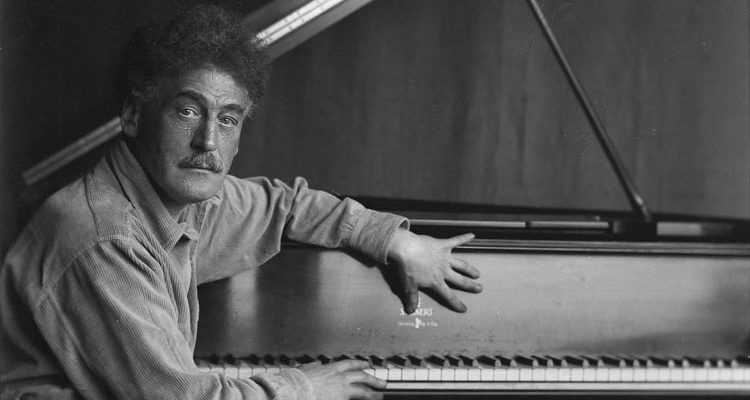
A great many pianists with major careers and significant reputations have faded from view after their death for a variety of reasons. One of these is the American pianist Richard Buhlig, a pianist-composer who studied with the legendary pedagogue Theodor Leschetizky, who taught some of the most renowned pianists of the 20th century (Schnabel, Friedman, Moiseiwitsch to name only three).
Born in Chicago (although his father was German) on December 21, 1880, the 16-year-old Buhlig started his musical training locally before moving to Vienna to study with Leschetizky, staying from 1897 to 1900. He gave his London premiere the following year and stayed in Europe until 1916 whereupon he returned to the US, becoming a professor at Julliard in 1918. He clearly made an impression while in Europe: while on his first tour he met the legendary Busoni, who would dedicate the third of his Fantasia contrappuntistica to Buhlig in 1910. It wouldn’t be long before Buhlig would return to Europe, and this time when he returned to the US it was to Los Angeles, which is where he died in 1952 after decades of touring, teaching, and composing.
A testimonial by John Cage in his work Indeterminacy indicates that Buhlig may not have on every occasion been the most charming man on the planet. This YouTube clip features Cage himself reading (together with some random ‘music’ as per the performance-art-like aspect of the work) about his first encounter with Buhlig:
Despite this less-than-auspicious beginning, it appears that the two did indeed become friends and work together, Buhlig offering suggestions to Cage about the structure of his compositions that he apparently took to heart. Cage would describe Buhlig as ‘a magnificent lion-like person, my first teacher.’ Others would speak highly of him as well: Buhlig’s pupil Sidney Cowell remembered him as ‘wonderfully enthusiastic’ while Charles Seeger found him to be ‘very charming’ (he likely wasn’t late for his appointments).
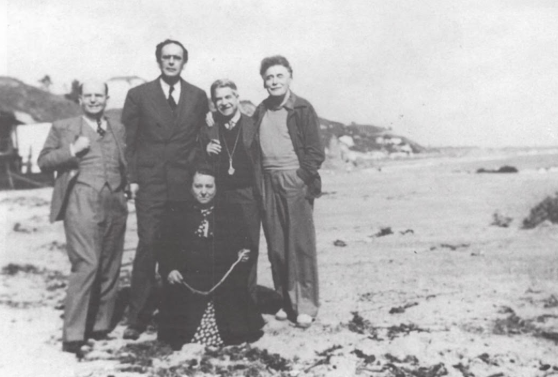
Buhlig’s presence in Los Angeles was a relief to the conductor Otto Klemperer, who moved to the US to escape the Nazis in 1933 and was named conductor of the Los Angeles Philharmonic in 1937. He had a hard time adapting to the city (he didn’t drive) and the different approach even amongst musicians there (he did not appreciate orchestra members referring to him as ‘Klempie’). They had a close mutual friend in Buhlig’s former classmate Artur Schnabel, and Buhlig’s being steeped in culture (his home was filled with books and art) and having lived for so many years in Europe made him ideal company for the great conductor.
Buhlig made no commercial discs, although he does leave behind some two and a half hours of recordings: his own arrangement for two pianos of the complete Art of Fugue and a series of solo recordings. The former was recorded professionally in a Los Angeles studio together with his student Wesley Kuhnle in the mid-1930s – Victor recording ledgers indicate that the cycle was recorded over the course of 12 sessions between November 18, 1935 and January 27, 1936. The two had played the opus in concert together over the course of several years at a time when Bach’s music was still not as widely played as it is today. These discs were seemingly distributed amongst other musicians but never released on the market until the CD era, in 2002. Fortunately the sound quality is very good and captures with great fidelity both pianists’ transparency of texture, deft articulation, beautifully shaped phrasing, and clear singing tone.
Buhlig’s solo recordings have were also never released during his lifetime and are unfortunately not of the same sonic standard as the Bach, but the playing is nevertheless worth hearing. While many artists who recorded privately kept the repertoire rather small-scale, Buhlig went for the gusto, recording Beethoven’s Hammerklavier and Op.109 in addition to Bach’s Chromatic Fantasia & Fugue BWV 903 – the sole short work he recorded was the Prelude & Fugue in F-Sharp Major BWV 858 (misidentified on the sole CD issue of this performance on the Dante label). Throughout these performances we can appreciate, despite the sonic limitations of the recorded sound, Buhlig’s exquisitely crafted phrasing, poised balance of primary and inner voices (what wonderful support in the left hand!), rhythmic propulsion and pulse, and mastery of tonal and pedal effects. Apparently he used to say, in regards to the Hammerklavier, that “you can play the notes or you can play the music.” Whilst he’s not careless in his technical command per se, there are moments when his passion overrides precision – it is clear from the reading presented here that the musical content is his focus in a performance that is both profound and filled with vitality – and both Beethoven Sonatas are given readings that are both intense and reflective, brilliantly highlighting the contrast that is so much a part of Beethoven’s writing.
0:00 Bach: Chromatic Fantasy & Fugue BWV 903
13:20 Bach: Prelude & Fugue in F-Sharp Major BWV 858
16:34 Beethoven: Sonata Op.29 in B-Flat Major Op.106 “Hammerklavier”
58:47 Beethoven: Sonata No.30 in E Major Op.109
Despite his having been virtually forgotten, Buhlig was a rather important figure in some regards, being the first pianist to play all 32 Beethoven sonatas as a cycle in Los Angeles (he did it twice in the ’40s at the Evenings on the Roof series) and having given the American premiere of Schonberg’s Drei Klavierstücke Op.11. Harry L. Anderson, a leading collector and authority on historical recordings, was a particularly ardent admirer, stating “I have never met anyone who played such a wide repertoire in his time, embracing all schools and periods from the English virginalists to Bartok, Copland, and Hindemith.”
What a tremendous shame that more of Buhlig’s clearly considerable artistry was not committed to disc. One hopes that some broadcast performances will be found (he gave several concerto performances in the 1930s). In the meantime, what exists of his recorded legacy is presented here.
Comments: 2
Thank you for the interesting article. Do you know anything about his composing?
Alas, I don’t… I hope that more information about all of Buhlig’s activities will be made available. He certainly seems to have been a fascinating individual! I’ll post an update here if I come across anything.