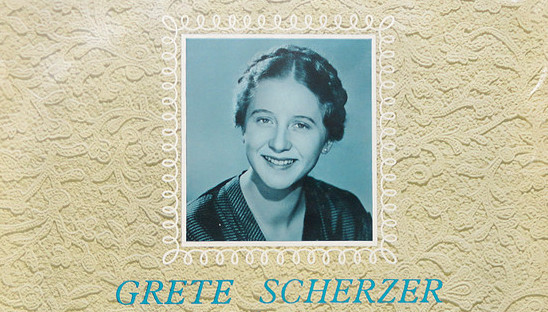
Austrian pianist Grete Scherzer had a short career before she retired from public performance but fortunately she left about two hours of recordings. Although these performances were produced in the 1950s for the Parlophone label and are in fine sound, they are relatively hard to come by and only a fraction of her output has been shared online, with none of it officially reissued since the original pressings. Now that some of her recordings have become accessible, the incredible pianism of this remarkable musician can now be heard and appreciated by a later generation of pianophiles.
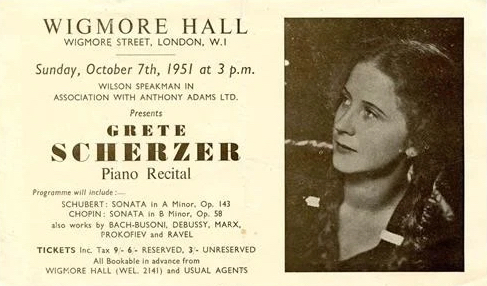
Scherzer was born in Wolfsberg, Austria in 1933. She started at the piano at the age of three and gave her first public recital at six, after which she began training at the Klagenfurt Conservatoire. She played a Mozart concerto with the Klagenfurt Symphony orchestra at age 9 and also made broadcasts from Graz, after which a scholarship took her to the State Music Academy, Vienna. She then appeared soloist with the Vienna Symphony Orchestra at the age of 14 and also began giving broadcasts throughout Austria. The 16-year-old won the 1949 International Schubert Competition in Geneva – the youngest ever winner – as well as the Vienna Music Critics’ Competition in 1950. She made her London début that year and was later invited to play at The Royal Festival Hall during the Festival of Britain.
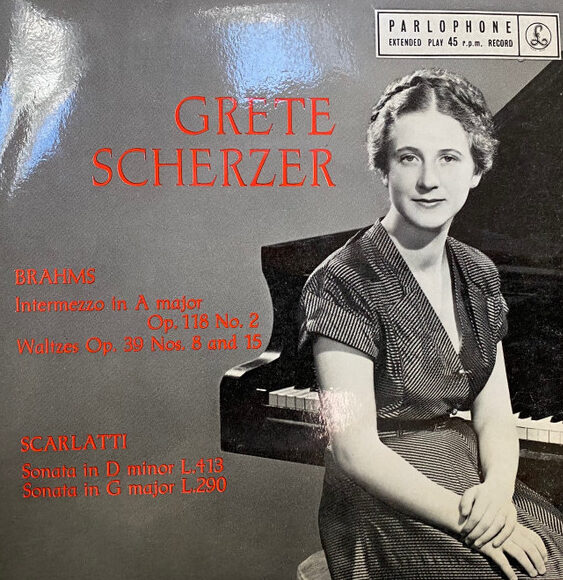
When she married architect and anthroposophist Rex Raab in 1957, she retired from public performance and little information about her is available from after that period other than the fact that she taught privately and died in 2007 in Winterbach, near Stuttgart. One former pupil commented on my YouTube upload that she taught at her home in Engelberg, Switzerland, with lessons being 3 hours long and taking place every two weeks. Another pupil in another upload commented that she was a wonderful teacher but very exacting.
Here is a series of solo recordings that Scherzer made for the Parlophone label in the 1950s. These are not her complete recordings for the label, but a selection of offerings that I could track down in 78rpm transfers. I offer a note of thanks to Tom Jardine, who assisted with declicking and noise reduction on a couple of the noisier transfers.
These performances are all exemplary in every respect: Scherzer’s tone is absolutely magnificent – polished and full-bodied at all dynamic levels – while her phrasing has a natural rise-and-fall shaping, as if sung by a great singer, with primary and secondary voices impeccably balanced. Her interpretations are naturally conceived, with attentive nuancing (particularly at transition points) and stylistically aligned with both the composer’s style and the work’s individual requirements, yet these readings never seem academic or detached. Scherzer was aged 18 to 20 when she set down these performances, and the pianistic execution and musical interpretations are absolutely of the highest order.
The recordings presented below are as follows:
𝐒𝐜𝐡𝐮𝐛𝐞𝐫𝐭
* Impromptu in G-Flat Major, D899/Op.90 No.3 (0:00)
April 16, 1952
* Impromptu in A-flat major, D899/Op.90 No.4 (4:31)
April 15, 1952
* Impromptu in A-flat major, D935/Op.142 No.2 (10:37)
April 16, 1952
* Waltzes Op.9A Nos. 1, 2, 3, 14, 12, 10 (15:21)
* Deutsche Tänze Op.33 Nos. 1, 2, 3, 7 (18:33)
(recording dates unknown)
𝐂𝐡𝐨𝐩𝐢𝐧
* Étude in E Minor Op.25 No.5 (21:47)
* Étude in G-Flat Major Op.25 No.9 ‘Butterfly’ (24:42)
March 14, 1951
𝐁𝐫𝐚𝐡𝐦𝐬
* Intermezzo in E-Flat Major Op.117 No.1 (25:49)
* Intermezzo in B-Flat Minor Op.117 No.2 (30:21)
July 9, 1953
𝐃𝐞𝐛𝐮𝐬𝐬𝐲
Pour le piano: Prelude (34:14)
March 14, 1951
Children’s corner:
V. The little shepherd (37:53)
VI. Golliwog’s Cake-Walk (39:44)
November 14, 1951
Préludes, Book II: XII. Feux d’artifice (42:06)
November 14, 1951
Thomas Deschamps produced for the February 2024 edition of the French magazine Classica a tribute page to the artist along with a CD featuring a number of Parlophone recordings: a couple of shorter works from the video above (in more pristine transfers) as well as others short works, plus more significant offerings in the form of Schumann’s Fantaisie and Ravel’s Gaspard de la nuit (both set down in 1953). That exceptional disc was available for a short time online yet regrettably seems not to be accessible any more. Here are some youTube uploads of some of the other works on that CD, including two more works by Schubert and these other two large-scale works.
More of her absolutely delightful Schubert: two Moment musicaux recorded April 15, 1952, played with the same sumptuous singing tone, seamless phrasing, and impeccable voicing as the Impromptus and dances in the clip above:
A powerful reading of the Schumann Fantaisie Op.17, recorded March 26-27, 1953 for Parlophone.
And finally, Ravel’s Gaspard de la nuit, which was recorded over the course of three sessions, November 19, 1952 and October 15-16, 1953. As brilliant as Scherzer was in her readings of Romantic repertoire, her impeccable fingerwork and rich tonal palette – and great musical sensibility – made her an idea interpreter of Ravel.
Scherzer also recorded one concerto each by Haydn (Concerto in D major, Hob.XVIII:11) and Mozart (Concerto No. 14 KV449) but I have not been able to locate copies of either. If you have access to these performances, please send me a message!
This elusive pianist’s very fine recordings are certainly due for a comprehensive reissue, and we can consider ourselves fortunate that the digital and online era in which we live makes her performances more reaily availab.e