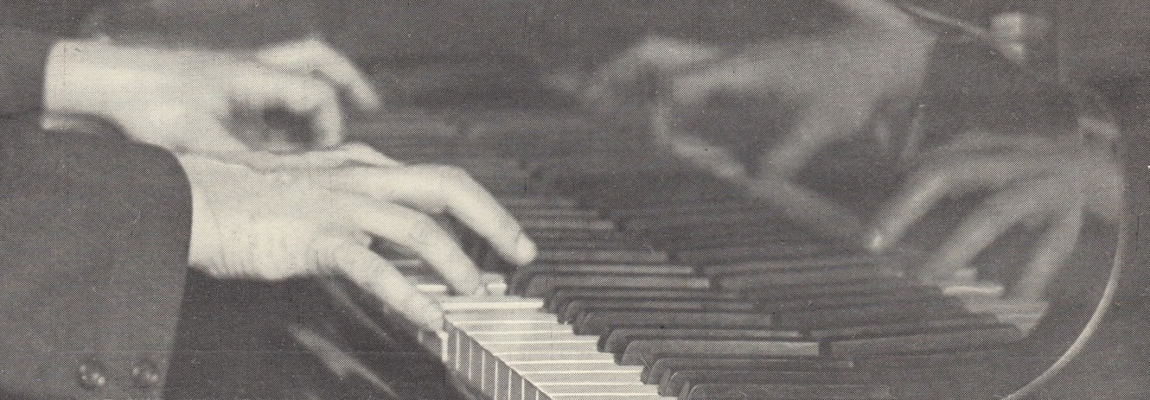
I continue to be astonished by how many great pianists continue to be off the radar because they recorded so little (if at all) and because these efforts were so seldom reissued, despite their artistic quality.
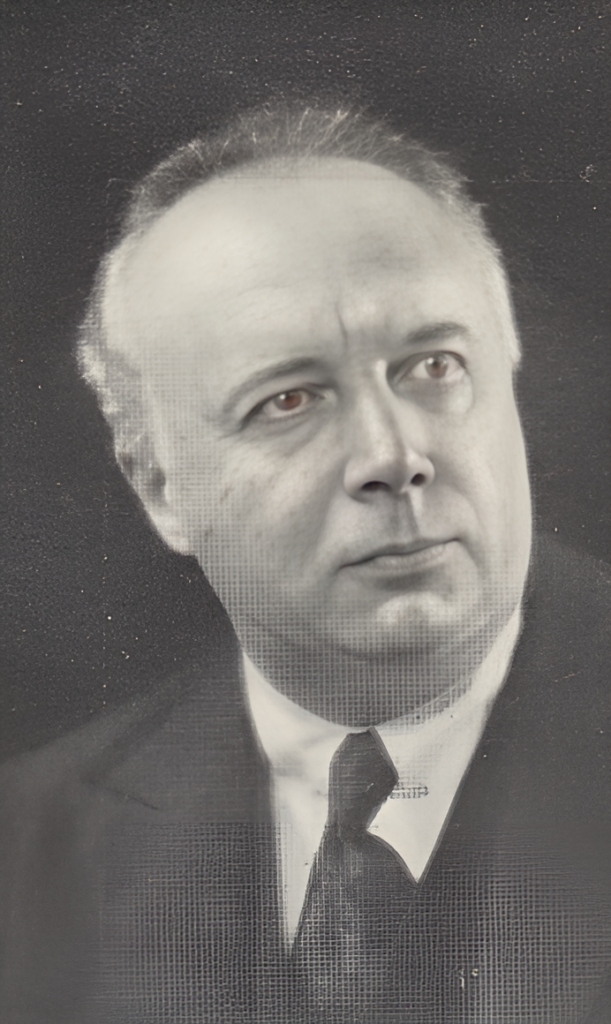
It was not long ago – in the last dozen years – that I first heard of the Dutch pianist-composer Dirk Schäfer (1873-1931) when I stumbled across uploads of a couple of his recordings for the Polydor and Columbia labels in 1924 and 1926. A reissue of his nearly complete 78rpm disc recordings had been only made published once, on an Opal label CD released in 1997 – only a few of these had been previously put on LP by a small Dutch label – and the playing is absolutely superb … at least on par with many of the major celebrated artists of the past, and better than some with much greater reputations! However, despite the superb pianism, some of these performances were only publicly available three times over the course of a century.
Schäfer was not a mere marginal figure at his time: he was a respected composer and quite a prominent pianist, but the narrow time frame in which he produced his recordings and their lack of regular republication has resulted in his being more overlooked than his pianism itself warrants.
His Life
Born November 25, 1873 in a musical & culturally oriented family in Rotterdam, Schäfer began his piano studies at the age of seven. By the age of 12 he was studying more seriously with Johannes Hendrikus Sikemeijer (known as Joh.H. Sikemeier), additionally learning the violin to the degree that two years later his teacher made him choose which instrument he wanted to focus on, By his mid-teens he’d already composed sixteen piano sonatas, four for violin and piano, a piano trio, a string quartet, some piano pieces, and songs to his own texts – but all of these were subsequently destroyed.
Facing hardship after the death of his father around this time, he obtained a grant to continue studying and in 1891 he traveled with his mother to Cologne, where he studied piano with Max Pauer while also pursuing training in composition. After three years – and a Mendelssohn Prize win in Berlin – he returned to The Hague and still struggled to make a name, despite successful tours to nearby countries, until his popularity increased around 1913. At that time he gave a series of ten recitals spanning the piano literature from Byrd to Schonberg; despite the emotional duress he experienced at curating and performing these challenging programs, he achieved great success.
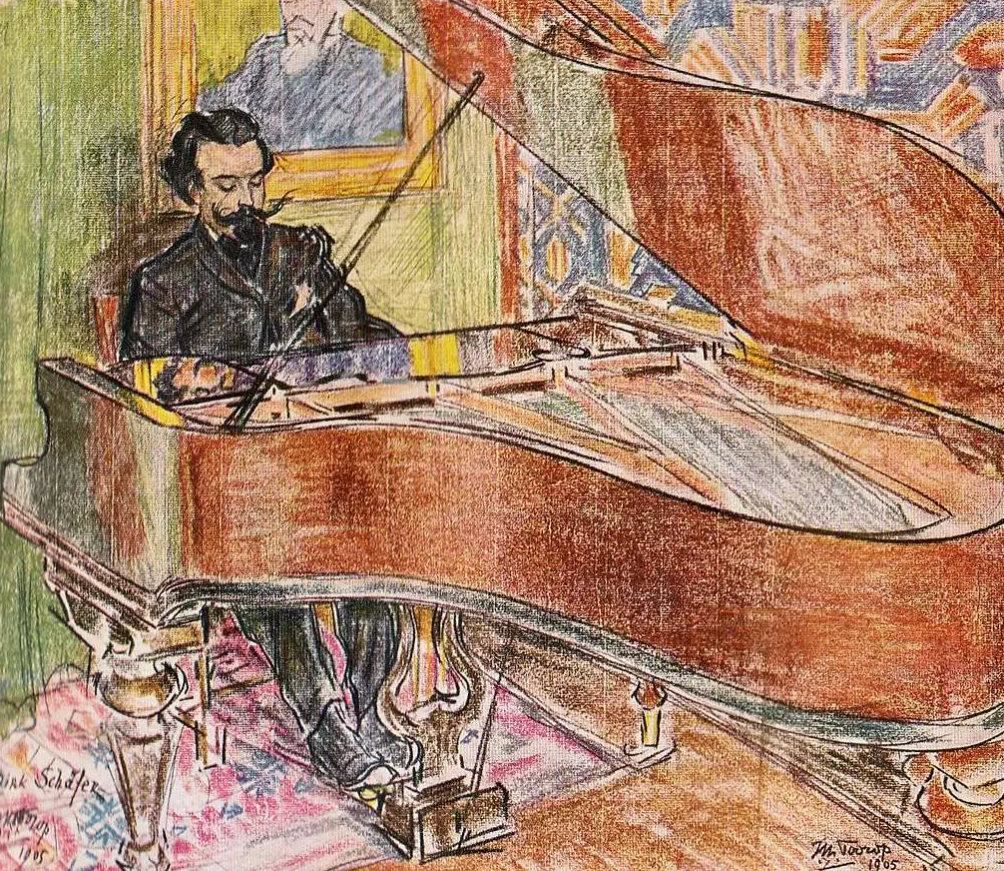
Although he had performed a number of concerti in his early concert career – Rubinstein’s Third, Beethoven’s Fourth and Fifth, his own Concerto in E-Flat (which he performed with Mengelberg), and the relatively contemporary Brahms Second – he would focus less on orchestral concerts to emphasise his solo recitals. One wonders the role that a rift with Mengelberg might have played. They had studied together in Cologne and Schäfer is reported to have felt outclassed by his compatriot. At a party for a fellow student’s departure, the two had been playing four hands and Mengelberg reportedly elbowed Schäfer off the keyboard, resulting in a grudge that the pianist never forgot.
Despite the pianist’s animosity towards him, Mengelberg conducted not just Schäfer’s Concerto with the composer as soloist in 1899 but he also led premieres of Schäfer’s Javanese Rhapsody (dedicated to Mengelberg) and Pastoral Suite in 1904, also leading many of the pianist’s fifteen or so appearances with the Concert-Gebouw Orchestra between 1896 and 1921.
In addition to all of his activities, Schäfer also produced a book entitled Het Klavier that was edited by his widow and published in 1942, more than a decade after his death on February 16, 1931. The city of Vlaardingen has a street that bears his name.
A tribute page online (link here) shares a few lines he’d shared that reveal some of his artistic philosophies:
Art directly reveals the truth.
There is an imperishable love in the artworks of the greats that is continually reborn in others.
Perhaps only a genius fully understands a genius.
There are two types of artists: those who go to the public and those who let the public come to them. Only the latter take us further.
Music analyses bear witness to poverty.
It is not the instrument that creates the master, but rather the master that creates the instrument.
Schäfer’s Recordings
Like many artists of his generation, Schäfer was not particularly enthusiastic about the recording process, much preferring the engagement of a live audience. Nevertheless, the 83 minutes or so of playing that he preserved on disc reveal some magnificent pianism, leaving one to wonder how well he might have performed when even more inspired. What we hear in his discs is direct and unostentatious pianism, elegant and refined even when impassioned.
There is a gorgeous singing tone that is discernible even in his faded 1924 recordings made with the acoustical recording process (with which the instrument’s sound was captured by a ‘recording horn,’ not a microphone). In the electrical 1926 recordings – which benefit from the improved fidelity made possible by the microphone – his subtle nuancing is all the more appreciable: what clear articulation, full tone, and refined dynamic shading and use of the pedal (there are some particularly breathtaking moments in the Mozart and Henselt). Although Schäfer preferred the Bechstein piano, his recordings were – according to the record labels – made on a Steinway.
Due to the 80-minute cap on CD timing, two works were left off the sole reissue of his almost-complete discography: a Mendelssohn Song Without Words and a Moscheles Etude. The dedicated Dutch pianophile Wim de Haan has transferred an original 78rpm disc with these performances (along with the Henselt from the other side of the disc) and has uploaded them on YouTube.
Here is my upload of the nearly complete set of 1924 & 1926 recordings, as issued by the Opal label:
Polydor recordings (acoustical process, 1924)
Chopin:
0:00 Waltz In G-Flat, Op 70, No 1 (Op Posth)
2:42 – Nocturne In F, Op. 15, No. 1
7:32 – Polonaise In D-Minor, Op. 71, No. 1 (Op. Posth.)
12:13 – Mazurka In A-Minor, Op 17, No 4
16:38 Ecossaises In D, G Flat, And D Flat, Op 72, Nos. 1-3 (Op Posth)
18:46 – Berceuse In D-Flat, Op. 57
23:27 – Nocturne In A-Flat, Op. 55, No. 1
28:24 – Waltz In A-Flat, Op 42
32:20 – Impromptu In A-Flat, Op 29
36:43 – Marche Funèbre From Sonata No 2 In B-Flat-Minor, Op 35
42:55 – Etude In A-Minor, Op 25, No 11
Columbia recordings (electrical process, 1926)
47:05 – Couperin: Soeur Monique
50:33 – Handel: Fantasia In C
54:27 – Mozart: Duport Variations (minus var. 3 & 6)
1:01:45 – Beethoven: Andante Favori (fragment)
1:05:39 – Henselt: Berceuse In G-Flat
1:09:33 – Chopin: Fantasie-Impromptu In C-Sharp-Minor, Op. 66
1:13:42 – Brahms: Waltz In E Major Op.39 No.2
Chopin:
1:15:35 – Etude In G-Flat Major Op.25 No.9
1:16:34 – Etude in C Minor Op.25 No.12
And here is the seldom-heard disc of the two works missing from the CD, uploaded by Dutch musicologist Wim de Haan – a Mendelssohn Song without Words and Moscheles Etude:
00:00 Mendelssohn – Lieder ohne Worte, Op. 102: III. Presto in C Major
01:20 Moscheles – Etudes Op. 70: III. Allegro brillante in G Major