It is tragic that many great pianists never had the career that their artistry warranted. For some it was management, for others luck, and yet for others, there is the sad reality of medical issues and other life circumstances. The great Polish pianist Mieczysław Münz was one such artist. After a very promising start to his career, he faced great hardship and was forced to give up public performance in 1941 when focal dystonia in his right hand prevented him from being able to play. He focused his energies on his teaching for the next 35 years, until his death in 1976 at the age of 75.
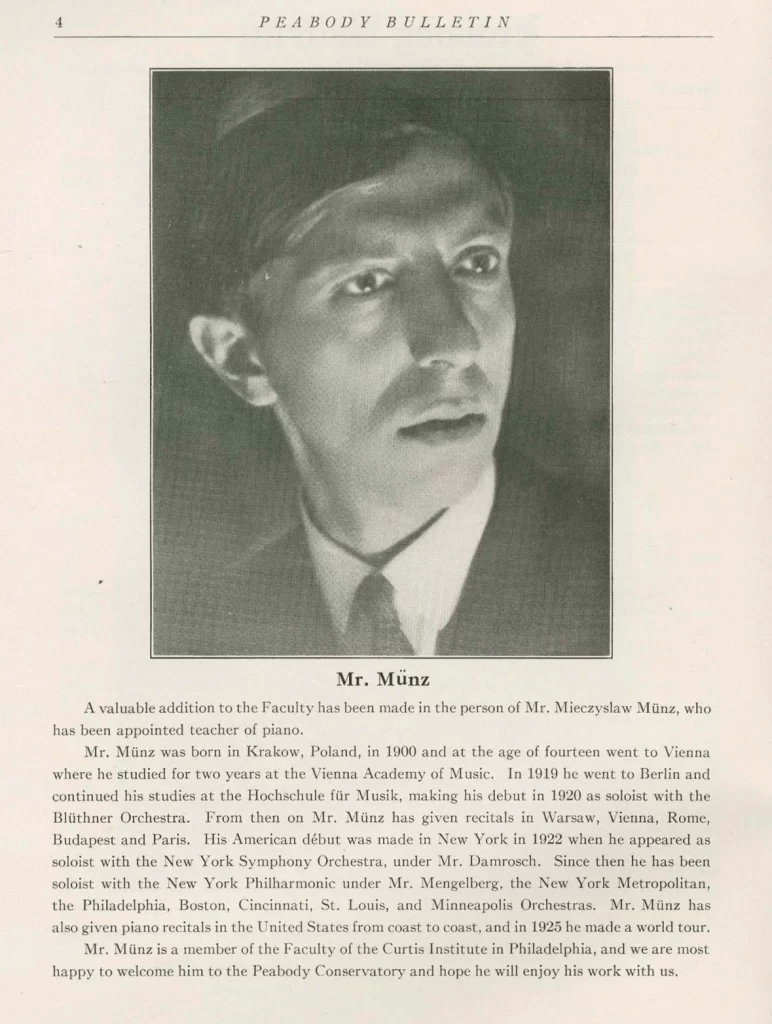
Born in Krakow, Poland on October 31, 1900, Mieczysław Münz showed signs of his musical talents when he began playing Polish folk songs at the piano by ear at the age of 3. Not much is known about Münz’s childhood or training prior to his entering the Krakow Conservatory at the age of nine. He would study with Georg von Lalewicz, who had trained with Annette Essipova, who herself had studied with and then married the legendary pedagogue Theodor Leschetizky. Within three years of beginning these formal studies, a 12-year-old Münz made his orchestral debut with the Krakow Symphony Orchestra, performing Tchaikovsky’s First Piano Concerto.
Two years after this debut, Münz moved to Vienna to continue training with Lalewicz, while also having a brief stint in the military during WWI. A move to Berlin in 1919 saw Münz not merely training with the legendary pianist-composer-pedagogue Ferruccio Busoni but also becoming the great musician’s assistant, which surely informed not just his pianism but the teaching that was to be the mainstay of his professional life. His debut in Berlin at the age of 20 saw him, in the tradition of Busoni, playing three concerted works in one evening: the Liszt E-Flat Concerto, the Brahms D Minor Concerto, and Franck’s Symphonic Variations.
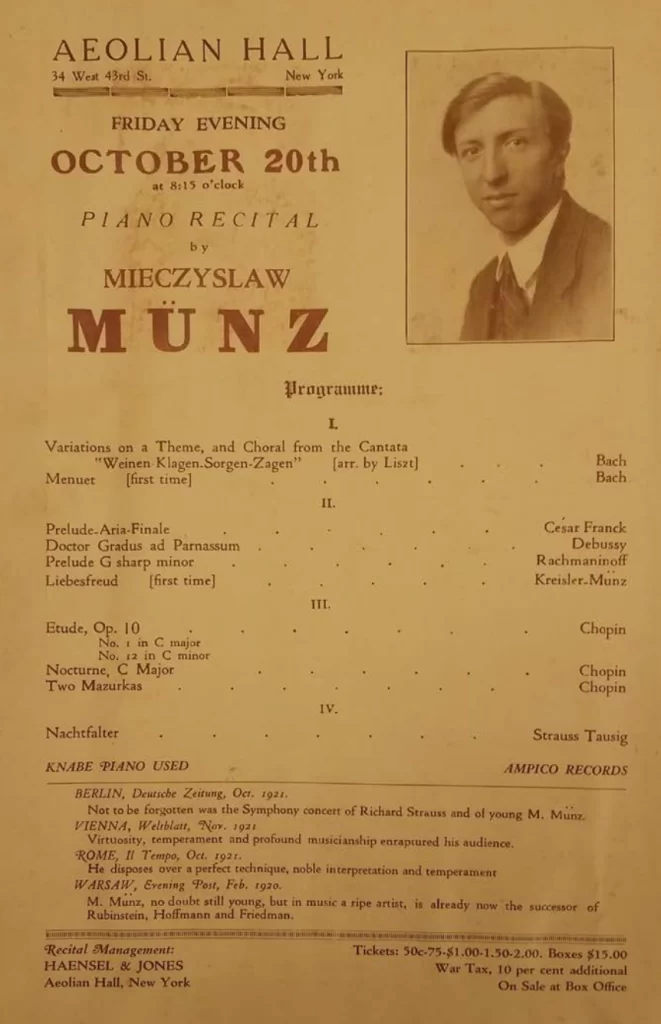
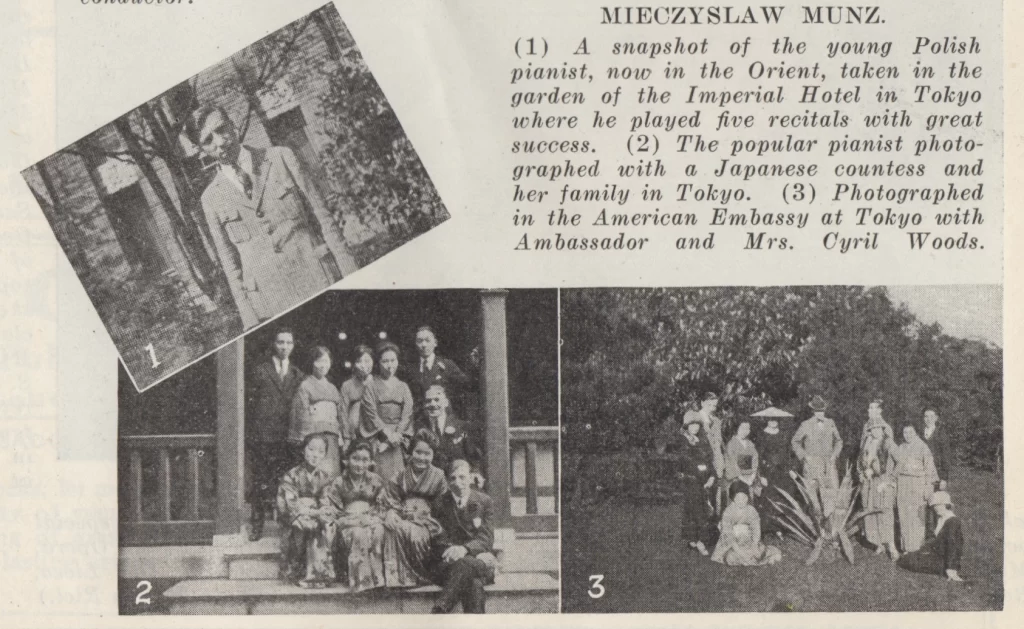
Münz made his New York debut at the Aeolian Hall on October 20, 1922, a resounding success that led to a second recital in the same hall that December. Another tour of the US in 1923 was then followed by 1924 tour of Japan, China, and Australia in which he played 80 concerts; this would mark the beginning of a half-century relationship with Japan, where he would regularly teach and where he was in the middle of a teaching contract when he died in 1976. Amidst these global successes, Münz decided in 1924 to move to the US, though he continued to tour internationally whilst already actively teaching.
A particularly memorable concert by the pianist occurred quite by chance when, on January 26, 1925, Münz went to attend the visiting Leschetizky pupil Ethel Leginska’s recital at Carnegie Hall. However, by 9pm the British pianist had not shown up (she was in the midst of a breakdown and was later found in a disoriented state), and the gracious Polish pianist offered to play instead – with a slight adjustment to the printed program. His playing was rapturously received and he gave many encores, with critics commending his “precision, grace and flexibility.”
Unfortunately, for all the successes he earned there were what appeared to be no shortage of challenges. Münz was greatly admired by the legendary Josef Hofmann, who invited him to be part of the piano faculty at the Curtis Institute of Music, while he continued to teach elsewhere, including the Peabody Conservatory in Baltimore.
At around this time he would experience one of the most profound losses of his life when his wife would leave him for his better-known compatriot Arthur Rubinstein. This story is more complicated than it might initially appear, and the details are shared here to set the record straight:
A 40-year-old Rubinstein had met the 18-year-old Aniela [Nela] Mlynarska in Warsaw in 1926, and the chemistry was immediate – but the older, more worldly pianist had long been a bachelor and was, Nela later recalled, somewhat apprehensive about marriage. He left on tour the next day and she did not hear from him – apparently because he thought she would write first, while she had been raised to wait for the gentleman to make the first move. When Rubinstein returned to Warsaw, he proposed again but was soon away on tour yet again, and so it all seemed rather like an unrealistic dream to the young lady.
In the meantime, Nela was being courted by Münz, who was far more forthcoming in demonstrating his affections, and Nela was upfront enough to clearly communicate to Rubinstein about the situation: “There is a young pianist, Mieczyslaw Münz, who wants to marry me. He is terribly in love with me. He sends me flowers and letters. I told him that I was in love with you but I admitted that I do not believe you mean to marry me.” She also told Münz about Rubinstein’s interest, and his response was to cancel appearances in the US to fly to be with her in Warsaw – as clear sign of interest and commitment as one could hope for, while Rubinstein, in Nela’s words, “went Buenos Aires to make money.” Münz not only demonstrated his devotion in time and gifts, but consented to the family’s request that he convert from Judaism to Catholicism, and so Nela accepted his proposal and moved with him to Cincinnati in 1929 – and her family followed, her father becoming a conducting instructor at the Curtis Institute.
Munz was teaching in Cincinnati when he was invited by Hofmann to teach at Curtis – which helped bring Nela closer to her family, since her father was on the faculty there as well. He additionally took on students at The Peabody Institute of Music in Baltimore, so it was a busy and fruitful time for his career. However, in 1931 Nela’s father’s health declined and he returned to Warsaw for treatment, and she followed soon after while Münz remained in the US. Back in Poland, she once again met with Rubinstein and the two committed to one another – not an easy situation, as Nela was still officially married to Münz. Several ironies followed: Münz’s father was a lawyer and took care of the legal matters. Meanwhile, because Nela was Catholic and therefore could not divorce, she converted to Judaism in order to do so, when Münz had converted to Catholicism so that he could marry her. Rubinstein would later write that “Münz behaved in the most noble way; in spite of the deep unhappiness he felt about losing her, he did all in his power to give her freedom.”
Periods of Adversity
It surely must have been heartwrenching for Münz to not only lose the love of his life to his more famous colleague but to then lose his teaching position at Curtis (for reasons not clear) around the same time. He continued teaching elsewhere and performing, though the particulars are not fully clear from available materials.
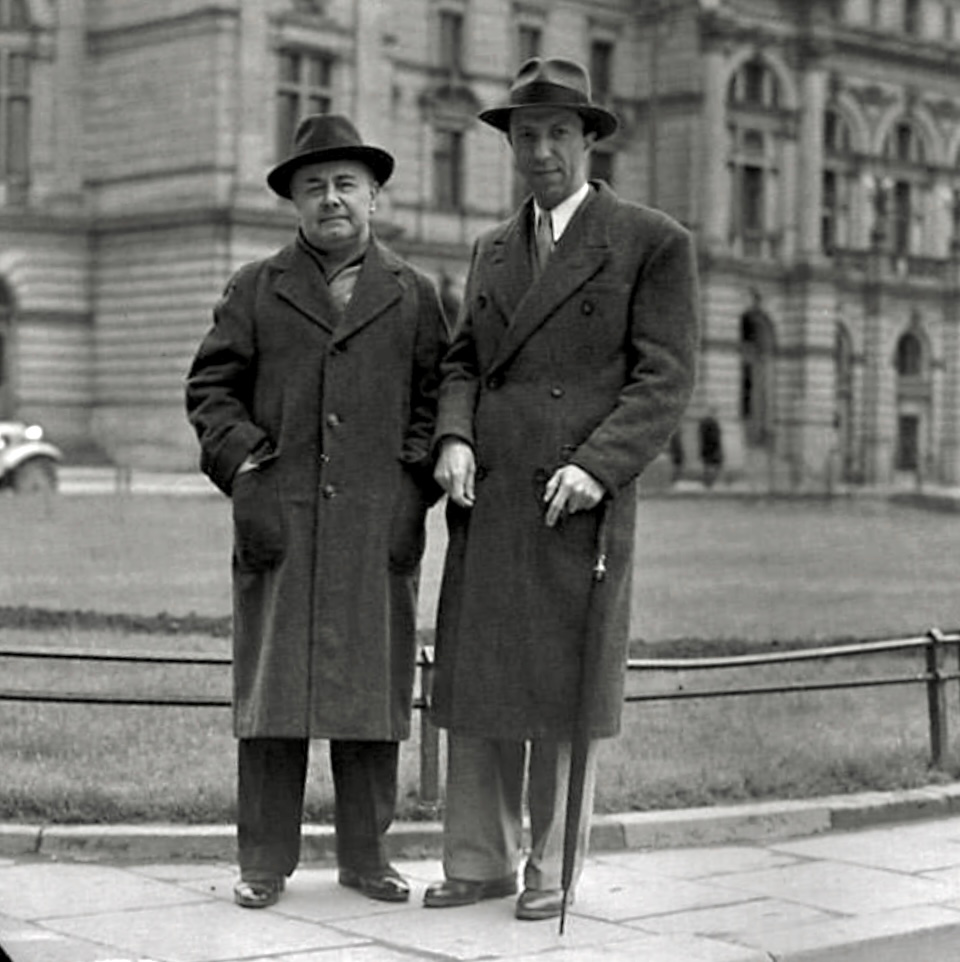
The great Josef Hofmann remained an ardent supporter, writing to Columbia Artists Management to suggest that Münz be his replacement for a Carnegie Hall recital which Hofmann would not be able to play, and he additionally wrote to NBC’s Samuel Chotzinoff in 1939,
“I feel that you would find Münz musically and personally very worthwhile, and considering his Radio experience – perhaps you might be able to help him back on his feet again. Please let me know if I am asking too much. I can’t help making this request because it makes my heart bleed to see a fellow artist as gifted as he is bearing in actual financial need. As ever yours, Josef Hofmann.”
Alternating highs and lows continued: in 1940 he played the Canadian premiere of Rachmaninoff’s Rhapsody on a Theme of Paganini (about which more below), in addition to playing at the White House for the First Lady. Yet early in 1941 he learned that much of his family – including his parents and brother – had been executed in concentration camps. In April of that year, he was once again engaged to teach at Curtis. That December he gave what was to be his last public appearance, a rousing performance of the Rachmaninoff Rhapsody (which was recorded and is shared further down this page) – the focal dystonia plaguing his dexterity had made it impossible for him to continue his performing career. He was let go from Curtis yet again after a year and he searched for cures for his hand while suffering from a lack of financial stability (Curtis director Mary Bok continued to send him money on occasion), eventually taking a nightshift factory job in Bridgeport, Connecticut in 1943.
The thought of such an artist being reduced to such basic labour is beyond disheartening to consider: Münz wrote that “It is not easy physically, but much harder morally,” adding, “I am trying to take it as brave as I can and I will be indeed happy to write to you more cheerfully as soon as my situation changes.” How long he continued to work in this position is unclear but in 1946 he ran into Reginald Stewart while walking on Broadway in New York; upon observing this “completely destroyed human being” Stewart invited Münz to lead the piano department at the Peabody Conservatory which Stewart himself was heading. It was around this time that Münz finally became an American citizen and could again fully embark on his career as a teacher.
A Revered Teacher
For the next 30 years, Münz would be an active and revered teacher, with many pupils of distinction, among them Emanuel Ax, Felicja Blumenthal, Sara Davis Buechner, Walter Hautzig, Eugene Indjic, Reynaldo Reyes, Ann Schein, and Ilana Vered. Ax noted that he never needed any other teacher, and all of his students have spoken glowingly about their master decades later, Schein noting, “I don’t know how you define him. I would say he was a poet.”
In the early 1960s, Schein’s recording of Rachmaninoff’s Third Piano Concerto was played to Artur Rubinstein at a dinner party by the widow of Artur Rodzinski; at first he didn’t want to listen – “I don’t want to hear another prodigy, take it off!” – but once the recording started Rubinstein silenced the 40-odd other guests so he (and everyone else) could listen more attentively. Rubinstein wanted to meet Schein and upon learning that she had studied with Münz, he invited her teacher to be present as well. It was the first time the two Polish pianists had met since Nela had left Münz, and despite some initial awkwardness, they were both extremely cordial and this occasion helped ease some 30 years of tension.
A decade or so later, Ax’s playing also helped to bring Münz and Rubinstein together: the young artist won the first Arthur Rubinstein International Piano Master Competition in 1974, upon which Rubinstein sent Münz an extremely cordial telegram:
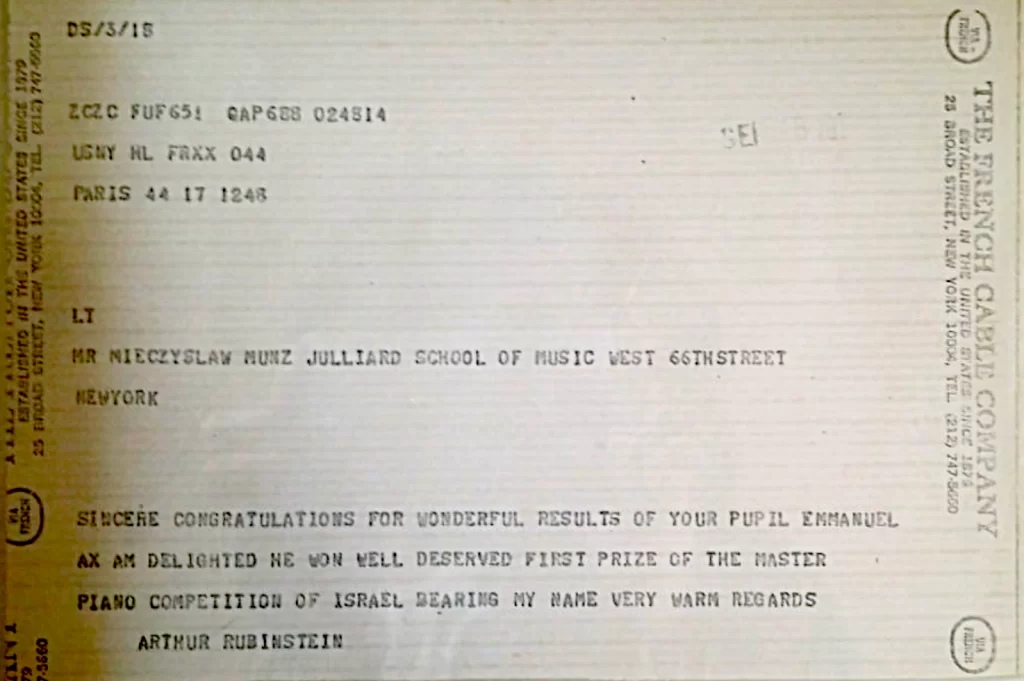
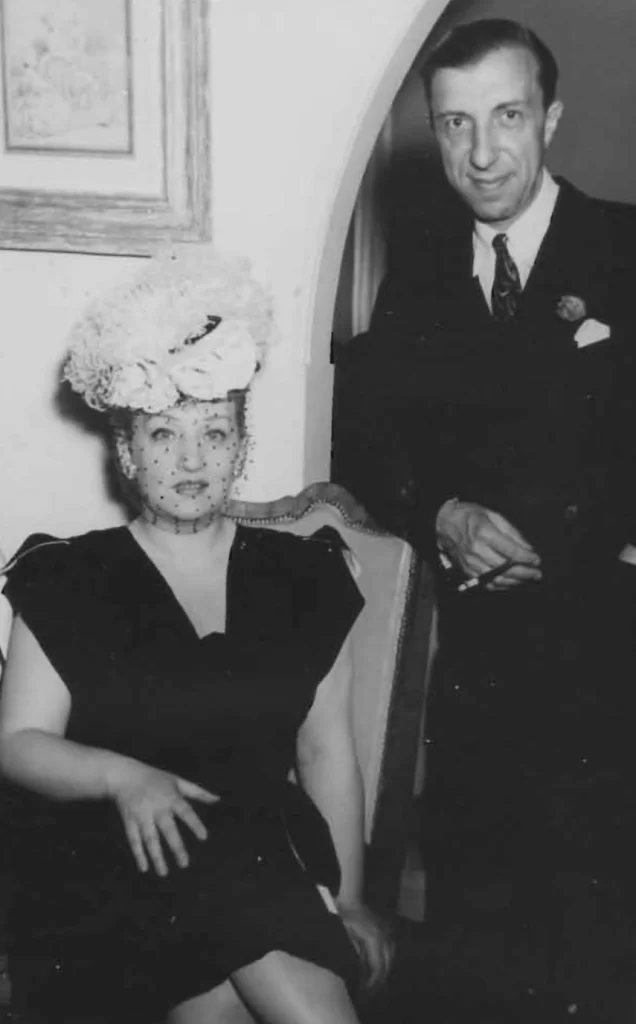
Münz was very proud of Ax’s accomplishments and of Rubinstein’s admiration, and sat in a box for the young pianist’s subsequent New York recital with an elegant woman who is believed to have been Nela – he is said to have been in tears through the entire performance.
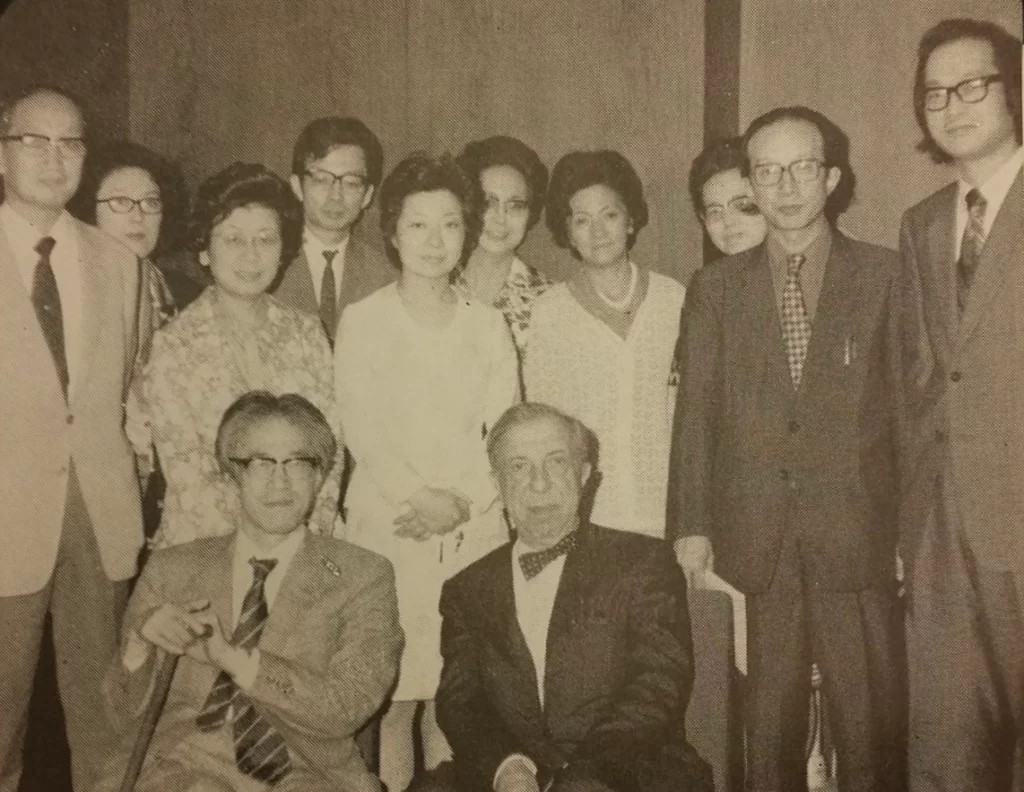
Münz was invited to be a Visiting Professor for two years at Toho School of Music starting in 1975, so he took a leave of absence from Juilliard. He had been visiting Japan regularly since 1924 and was greatly admired there (as he was in Korea, where he regularly taught). He fell ill in his first year there and returned to the US for medical treatment in May 1976, and he suffered a heart attack in August that year. He spent his last few days in a hospital, where he converted back to Judaism before he died on August 25. The rabbi that converted him spoke at his funeral, describing him as “one of the most remarkable human beings he had ever met.”
The Pianism of Mieczysław Münz
Münz stopped performing after his December 1941 performance of Rachmaninoff’s Rhapsody on a Theme of Paganini, and regrettably no private recordings of him made at a later date appear to have been made. What survives of his artistry, other than the legacy shared by the students who continue to revere him, are a number of Ampico piano rolls, one sole 78rpm disc from 1928, a short broadcast of a solo work, and two broadcasts with orchestra; fortunately the unofficial recordings bolster his meagre official recorded output, but it still not sufficient for an artist of who had once been Busoni’s assistant and was admired by Hofmann, Rachmaninoff, and other legends. All of these performances were issued on a single CD on Americus Records, only once in 2002 – “The Art of Mieczysław Münz”, produced by Walter Hautzig and Lenny Popkin with a grant by the Anne and George Popkin foundation. The result of his scant recorded output and its longtime inaccessibility is that even dedicated pianophiles have not heard the playing of this supreme artist – so his mastery is far less appreciated than it should be.
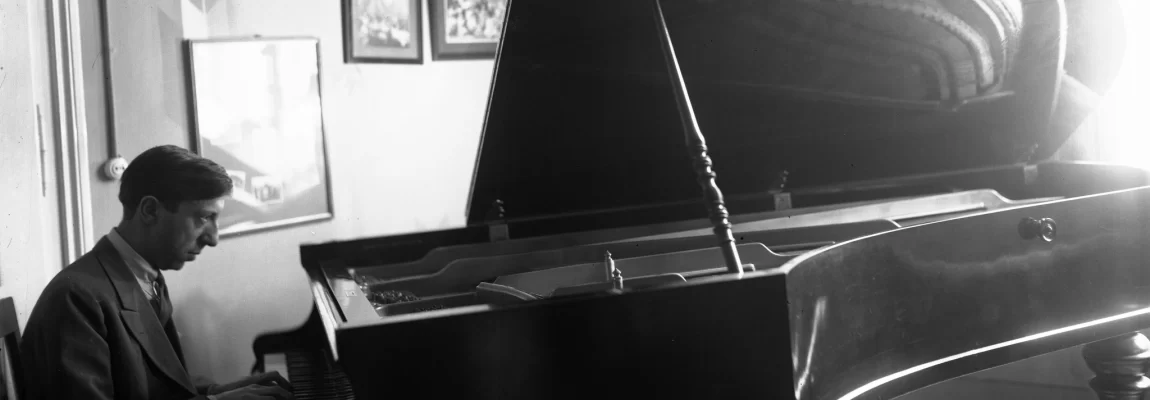
There is some silent film footage of him playing in 1929 that is fascinating to watch (and also noteworthy as it shows his then-wife Nela in the background):
Münz’s single official recording is a ten-inch 78rpm disc the Homochord label in 1928 (which was also released on Decca), in which he plays the Scriabin Etude in C-Sharp Minor Op.2 No.1 and Ravel’s Piece en forme de Habanera. His playing here is, as in the other extant recordings below, superb: beautiful tonal colours (appreciable despite the age of the recording), impeccable voicing, natural timing, and sumptuous nuancing. (Many thanks to Tom Jardine for his superb transfer of an original 78 from his personal collection.)
Of the handful of unofficial recordings to surface are one solo work, the Délibes-Dohnányi Waltz from Coppélia, in which he demonstrates his dazzling dexterity, glowing tonal palette, and marvellous dynamic shadings.
One of the two appearances with orchestra to have survived is an October 17, 1940 concert performance of Mozart’s Piano Concerto No.20 in D Minor K.466 with Frank Black conducting the NBC Symphony Orchestra. It appears that Münz was the first pianist invited for the inaugural series of concerts dedicated to the concerto repertoire, as per the announcer’s preamble before the concert. Unfortunately, the announcer cuts off the final measures of the final movement, which was apparently already played at a remarkably brisk tempo because the radio producers indicated that there might not be enough time to play the last movement in the time allotted for the broadcast.
Nevertheless, the playing is marvellous, and we can appreciate Münz’s wonderfully clear sonority, precise and even articulation, transparent voicing, and beautiful singing line. It is worth noting that he plays the Hummel cadenzas in the first and last movements, in addition to a Hummel Eingang at 1:42 in the finale (21:13 in the complete clip).
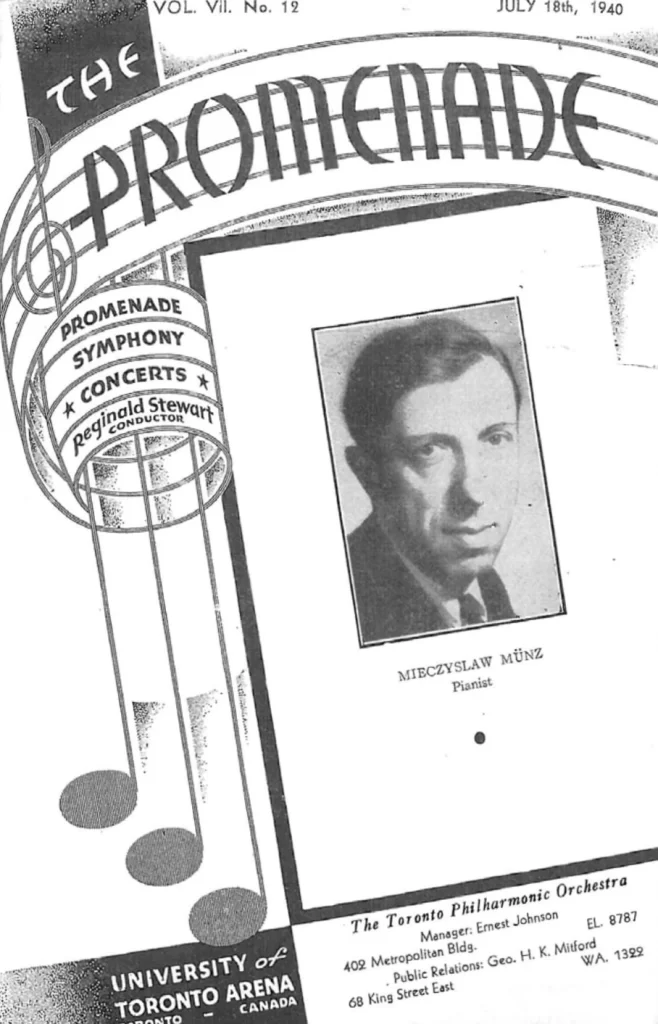
Münz’s December 8, 1941 concert of Rachmaninoff’s Rhapsody on a Theme of Paganini with the National Orchestral Association conducted by Leon Barzin appears to have been his final public appearance on stage. Münz had given the Canadian premiere of the work in Toronto the year before (the piece was only six years old at that point) and his playing was admired by the composer himself, who is reported to have greeted his Polish colleague – who had gone backstage after a recital by the Russian master – with the humourous retort, “Get away from me: people keep telling me that you play my Rhapsody better than I do!”
Certainly his playing in this 1941 broadcast is superb – even if Münz himself thought otherwise. A few days after the performance, he wrote to Mary Bok, head of the Curtis Institute, that “under difficult circumstances, everything went better than expected and at the end I received quite an ovation. Unfortunately, I personally know how much below my usual standard this performance was, but your kind words cheered me up and gave me hope for a full recovery in the future.” Alas, it was not to be.
The focal dystonia that ended his performing career had reached a critical point and he was in tremendous pain during this concert, yet there are no audible signs of strain in his playing. Münz displays a fascinating fusion of strength and sensitivity, with a different take on Romanticism than is the case eight decades later: he employs a more subtle rubato along with a more strongly defined line than one might hear today in works that often receive overly sentimental readings, yet there is plenty of emotion expressed through his tonal and dynamic shadings (notice how he adjusts both simultaneously), as well as through his soaring phrasing.
The pianist’s former pupil Sara Davis Buechner continues to be effusive in her praise of Münz, having studied with him just over a year until his death in 1976: “I rather adored that man – he was the Dad I didn’t have enough time to get to know. Phenomenal musician and teacher. He gave off quite a Buddhistic aura, too, like he knew everything.”
Buechner describes Münz’s exercises (learned from Busoni) to make anything at the keyboard possible (‘magic tricks’): “He was a great proponent of rhythmic variants as thorough technical practice and training. Such exercises made the practicing of a two-minute Chopin etude take up to 2 hours, to go through thoroughly. And you understood that to master such a piece, you’d work on those rhythmic variants every day. That kind of slow, detailed work puts your mind into a Buddhistic zone of concentration, but it trains the fingers remarkably and the results are powerful. You can hear the easeful fluency in Münz’s playing… The point for me, as a pianist, is that when I faithfully executed Münz’s many technical exercises, I felt wholly secure at the piano, with the freedom to just interpret without even thinking about technical demands, on stage.” She describes his playing during lessons: “The tone just opened up and swallowed the room in velvet sonorities. The sound of his gigantic paws roaring out the finale of Chopin’s Third Sonata — my God, that was an orchestra. He made it all look easy.”
A man who led a difficult life – his wife leaving him for Artur Rubinstein, losing family in the Holocaust, years of stress and financial strain, having his performing career end due to hand problems – Münz nevertheless relished his teaching and his students all appreciated him tremendously. He is an artist whose name deserves to be remembered – and pronounced properly!
To which end, an excerpt from the Florence Times Daily, Florence, Alabama USA, December 5, 1940:
It is not necessary to sneeze when you pronounce the name of Mieczyslaw Münz, the celebrated Polish pianist, who will appear at the Sheffield High School Auditorium at 8:15 o’clock tonight under the auspices of the Muscle Shoals Cooperative Concert Association. The pianist assures everyone that it is quite easy. The last name is pronounced “Mince,” like the well-known pie. The first name (it is the name of a Polish national hero, by the way) does offer some difficulty to American tongues, but this too becomes simpler upon analysis. “Mee-aich-chis-laff,” accented on the second syllable.
During the first visit of Münz to America — several years ago — one of his admirers who had mastered both prononciations, was so carried away by the brilliant Münz art — and name, that he addressed his letter to the “Variations” column of the Musical Courier:
“Dear Variations:
I will not Münz matters, but come to the point at once. Mieczyslaw was soloist with the orchestra today, playing the difficult Liszt Piano Concerto in A major. It was pie for the boy — Münz pie. The most astonishing piece of Münzstrelsy heard in the state of Münz-sota in some time or I am greatly Münztaken.”
The Polish pianist, who knows English very well, took pen in hand:
“In spite of beseechings and hints
That plays upon words make me wince,
My friends take my name
And make puns on the same.
“Woe is me!” cried Mieczyslaw Münz.”
Many thanks to Sara Davis Buechner and Ann Schein for sharing their recollections of Münz, and to Sora Lee, from whose 2016 thesis “The life and legacy of MieczysLaw Munz” some key details and images were sourced.