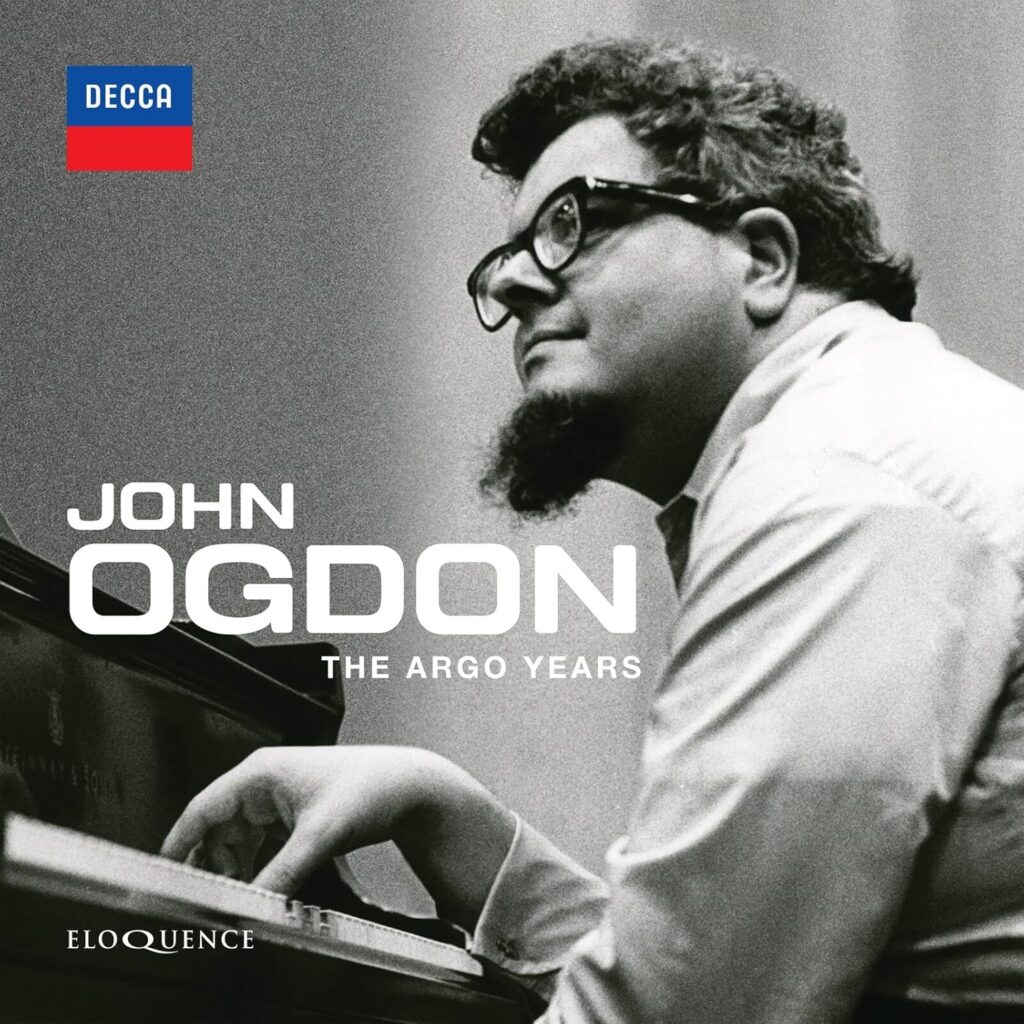
I was delighted to be commissioned to produce the text for yet another incredible release on the superb Eloquence label, one featuring John Ogdon’s recordings on the Argo label. These performances were captured at a key period in the pianist’s fascinating but troubled life and career, and it was an honour to be able to write about him and these performances. You can read more about the set itself here and purchase it here and here.
In the mid-1950s, a young John Ogdon was walking with a friend down the seafront at Hastings when he stopped, grabbed her arm, and said, “Please be honest with me – do you think I’ve any talent?” A quarter century later, in an appearance on the BBC Radio program Desert Island Discs that aired mere months before he died, Ogdon acquiesced under pressure that he was “relatively talented … I suppose.”
Others were less restrained in their praise for the pianist. It was not long after the seafront walk that a nearly octogenarian Egon Petri would write, “I can now say quite definitely that I have rarely met such musicianship, technical ability, ease, and achievement, besides wide knowledge, in one so young. For me as a teacher he is quite disarming, because there is so little to tell him.” To Sir Adrian Boult, Petri wrote that “he really astonishing, quite a pianistic genius and only 20 years old… he should make a name for himself very soon.”
That one of the most prominent disciples of Ferruccio Busoni should write so glowingly about the young artist indicates the tremendous talent that Ogdon possessed yet seemed reluctant to publicly acknowledge. Decades after his premature death in 1989 at age 52, Ogdon continues to be considered one of the most prodigious pianists of the 20th century. His ample discography spanning over three decades is an important testament to the wide-ranging artistry of one of the piano’s most unique proponents, with the Argo recordings in this volume capturing him at a vital turning point in his remarkable but troubled life.
There was no doubt from a very young age that Ogdon had extraordinary musical aptitude. The fifth and last child in his family, John Andrew Howard Ogdon was born January 27, 1937. His inclinations were evident early on when at age 2 he was drawn to the mechanised player piano in the family’s drawing room. The boy would scan the scrolling paper through the front of the instrument while delighting in the movement of the keys, and then try to play on his own, when at the time he was barely tall enough to see the keyboard. He even devised his own means of composing original works by cutting paper to imitate the appearance of the perforated scroll moving through the instrument – all this before being able to speak, read, or write. It is fitting that his approach should have been so intuitive and unconventional: these were both his strengths and weaknesses throughout both his training and his professional life.
The first piano recital Ogdon attended also had a profound influence on him. Hearing Hungarian emigré Louis Kentner in concert gave the six-year-old child his first real reckoning of how a pianist could communicate in a hall, and the experience cemented the boy’s ambition to share music with others. He took to practicing the noble artist’s bow as he himself began to play for others, first at home and other private settings and then at school.
The family moved to Manchester when John was nine and he was enrolled at the Royal Northern College of Music, the youngest pupil to be admitted. He was fortunately wholly accepted and treated very kindly by his older colleagues, who admired his remarkable talents. Ogdon studied with Iso Elinson, whom he’d heard perform the complete Beethoven Sonatas in recital. The Russian-British pianist, whose own musical lineage included links to Anton Rubinstein and Felix Blumenfeld, grew frustrated by his young pupil’s avoidance of classical repertoire and structured teaching, eventually exclaiming to the boy’s mother, ‘Please take him away!’ Ogdon, however, greatly admired the teacher who introduced him to the music of Scriabin and taught him to play without creating extraneous noise while striking the keys.
Ogdon’s parents chose to pause the boy’s musical training so that he could obtain a general education, but he continued to practice on his own and at sixteen he returned to the RNCM to study both piano and composition. Two months after participating in the 1956 Queen Elisabeth Competition in Brussels, from which both he and his future wife Brenda Lucas were eliminated, Ogdon would on July 16 perform the Brahms D Minor Concerto with the great Sir John Barbirolli on the podium. After his graduation with top honours, he continued with advanced studies while being booked for solo and concerto appearances across the country and for broadcast performances on the BBC.
It was in the winter of 1957-58 that the 20-year-old pianist went to Basel, Switzerland to study with Egon Petri. Ogdon had been only nine when he entered Ronald Stevenson’s practice room, mesmerised by the exotic flavour of the Busoni Piano Concerto that his older colleague was practicing, so the opportunity to train with one of the pianist-composer’s preferred pupils was irresistible. He was elated study ‘the Concerto’ with the pianist who had played it more than once with the composer conducting (including the British premiere) and Petri was stunned that Ogdon not only arrived without a score but that he could in a flash pick up wherever he was interrupted. Their six weeks together saw Ogdon deepen his overall approach to interpretation and technical challenges, though Petri noted that ‘all he needs is to curb his temperament – he often plays much too fast … to make all passages absolutely rhythmically controlled … in short to go into more detail.’
His career began to grow by leaps and bounds with more high-profile engagements. He gave his first performance of the Busoni Piano Concerto in London not long after returning from Basel (nearly a half century after Petri’s London concert with the composer), the following year appearing with orchestras led by esteemed conductors like Barbirolli and Basil Cameron – the latter with whom he made his first Proms appearance in 1959 – prior to his London recital debut at Wigmore Hall. He won first prize in a London-based Franz Liszt Competition (not the competition in Hungary, as often erroneously reported), the televised final round putting Ogdon’s name even more on the national radar. He saw a further increase in bookings and became the go-to for last-minute replacements for ailing artists, which led to him acquiring the moniker ‘Slogger Ogger.’
The biggest turning point in his career, however, was at the 1962 International Tchaikovsky Competition where he shared first prize with Vladimir Ashkenazy. After Van Cliburn’s breakthrough win four years earlier, Ogdon’s tie with a Russian during the ongoing Cold War was an unexpected and significant triumph. Also remarkable is the fact that he flew back to the UK between rounds in order to fulfil a previous obligation to play the Tchaikovsky Concerto, an act that nearly disqualified him: it was suggested that a mid-competition performance of the same work that he would play in the finals would give him an unfair advantage. However, he was allowed to do so, and he had a blazing success in the final round, with a four-minute ovation from the Russian audience.
Ogdon’s choice to fly back and forth to Moscow during the competition was an early sign of the gruelling schedule to which he would continually subject himself throughout his career, a major factor in his breakdowns. It is said that he routinely played 200 concerts a year – ‘not a way to live’ as some colleagues noted – while regularly accepting lower fees than the norm for an artist of his stature. His father had suffered serious mental illness and spent time in an asylum (he published a book about it), Ogdon’s first pronounced symptoms became evident on an American tour early in 1971.
As his breakdowns became more severe and frequent, concerts and tours needed to be canceled, and he spent time receiving psychiatric care and – early on – electroshock therapy, a controversial but seemingly necessary choice. Ogdon required several breaks over the years from public performance and when he returned, his playing and personality could be erratic – ‘a loose cannon,’ as one colleague referred to him – but there were many occasions where the magic of his musical gifts were still in full abundance. A week after a London recital, he died unexpectedly on August 1, 1989 at the age of 52, as a result of pneumonia exacerbated by undiagnosed diabetes.
The pianism of John Ogdon is unique in its paradoxical nature. He was capable of playing with incredible passion and volcanic intensity whilst also producing the most delicate pianissimo with refined tonal shadings. He had truly transcendent technique but could at times be surprisingly lax in terms of both accuracy and rhythmic pulse. His capacity for learning works at lightning speed was astounding and his memory exceptional – he could write out excerpts from scores with flawless accuracy – and yet in the heat of the moment he could have lapses. At his best, however, the power, depth, honesty, and conviction of his performances could transcend all of these potential weaknesses and fully transport the listener to the heart of the composer’s creation.
Liszt and Chopin biographer Alan Walker produced live and pre-recorded BBC sessions with Ogdon at the time the recordings in this set were made. On one occasion, the pianist and his wife arrived an hour before a live transmission, with Ogdon carrying the scores for the works he was due to play; he requested a page-turner for his pre-broadcast practice, and at that late hour a janitor was the only available individual. What followed was shambolic playing with fistfuls of wrong notes that caused great concern to the producer. ‘Don’t worry,’ Lucas said to Walker in the recording booth, ‘he hasn’t played these works in a while’ – words that were hardly reassuring. When the red light came on, Ogdon played – without scores or page-turning janitor — with impeccable technical precision and musical nobility.
These Argo recordings were produced from 1969 to 1972, at a time when Ogdon was recording for multiple labels simultaneously – among them HMV, RCA, and Classics for Pleasure – several of these being two-piano performances with his wife. While John’s relationship with Brenda has been the subject of scrutiny over the years, it was their shared love of music that brought them together and their duo recordings – particularly at this pivotal time – are a testament the roots of their connection. Lucas had by this point abandoned thoughts of a solo career, a 1970 memo to the BBC from their agent Ibbs & Tillet announcing that she was only available for two-piano engagement with John.
The couple’s January 1969 Argo account of Mendelssohn’s Concerto in E Major for Two Pianos was their second recording together, this performance of a vivacious work by the young composer embodying the optimism they might have held for their life together. On the same disc Ogdon recorded the composer’s early Piano Concerto in A Minor, a surprisingly simple work for such a towering virtuoso – particularly one drawn to more robust Romantic repertoire. Despite concerns by Elison, Petri, and Denis Matthews that Ogdon was less adept with steady rhythm and more formal frameworks, his playing here is exquisitely refined. (full playlist here)
Appended to this first Argo disc is an often overlooked June 1983 account of Mozart’s Quintet for Piano, Oboe, Clarinet, Horn, and Bassoon in E-Flat Major K.452 produced for the Decca label. Here too we witness Ogdon’s clarity and precision in music that is outside the repertoire for which he is usually celebrated. (on playlist here)
The leap from Mendelssohn and Mozart to Messiaen might seem quite unfathomable for many a pianist, but Ogdon’s breadth of repertoire and interest in contemporary music finds him at ease in the evocative sound world of the French composer’s output. Ogdon is said to have learned Messiaen’s extraordinarily challenging Vingt Regards sur l’Enfant Jésus in two and a half days in 1955 when a pianist due to play the opus at Manchester’s Modern Music Society had withdrawn on short notice: he apparently agreed to fill in despite knowing nothing about the music, and when asked if he wanted to see the score first, the reply was ‘No, it’ll be OK.’ While this may seem inconceivable, it is not the only report of Ogdon’s astonishing capacity to quickly learn and remember the most complex of works.
His December 10-12, 1969 recording of the 20-work cycle was among the first few in the catalogue, preceded by Messiaen’s muse Yvonne Loriod and an obscure account by Thomas Rajna; Michel Béroff’s version was recorded a few months before Ogdon’s and issued around the same time. If those more familiar with the score can note the occasional lapse in rhythmic or textual exactitude, the ambiance that Ogdon cultivates is as transcendent as the metaphysical subject matter of the opus. A 1962 Cheltenham Festival performance was commended for the pianist’s capacity to go ‘from an enormous sound to a nothing sound’ and the same mesmerizing dynamic control is in evidence in this studio account. (full playlist here)
In eight sessions between December 1969 and December 1970, Ogdon set down more Messiaen with his wife: the two-piano Visions de l’Amen. This too was among the first few recordings in the catalogue, preceded only by the composer’s collaboration with Loriod and the then-teenaged duo of Katia & Marielle Labèque. This performance too was found by some contemporary critics to lack the nth degree of ensemble and cohesion, yet it still admirable for its rich tonal colours and atmospheric effects. (full playlist here)
Furthering Ogdon’s exploration of 20th century repertoire in his Argo discography are accounts of Shostakovich’s Concerto for Piano, Trumpet, and Orchestra and Stravinsky’s Capriccio, both set down over the course of three days in mid-December 1970. The biting rhythm and piquant harmonies in both works are well served by Ogdon’s vivacious enthusiasm, deft articulation, and transparent textures. (full playlist here)
Ogdon’s final Argo recording dates from mid-May 1972 – not long before his first major breakdown – and finds Ogdon and Lucas playing three sets of two-piano works by Liszt and Schumann (the Canonic Studies by the latter transcribed for two pianos by Debussy). Liszt’s Concerto Pathétique in E Minor is particularly successful: Ogdon was a dedicated and passionate proponent of Liszt – whose music was not always in favour at the time – and the performance is exquisite, with both dramatic depth and lyrical beauty, with wonderfully coordinated playing by the husband and wife duo. (full playlist here)
Any musician’s playing and artistic output are inextricably linked to their life circumstances, though at times the connection is not always fully evident. With Ogdon’s life having taken a torturous and tragic turn soon after these recordings were made, these largely-overlooked performances provide an opportunity to greater appreciate the multifaceted scope of his extraordinary pianism.