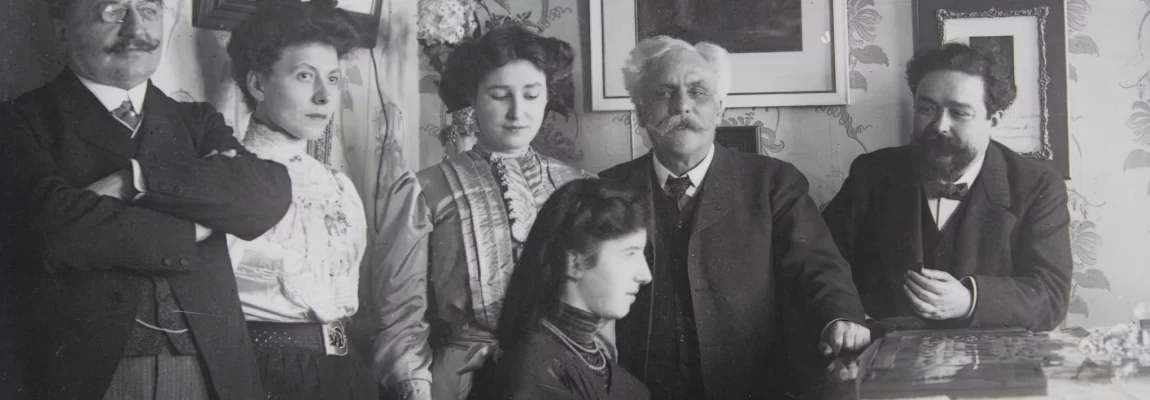
As has been explored in a number of my features on great pianists, not all supreme artists left behind commercial recordings. While a contract to make records was often a sign of prestige, in the first decades of this technology most particularly, many musicians chose not to preserve their performances in sonic form. Some, like Carl Friedberg, was averse to anchoring a single interpretation for posterity, while others (like Jascha Spivakovsky) were not enamoured with the sonic limitations of the evolving technology. It must be recognized that the lack of commercial recordings is not a sign that an artist was not an important or skilled musician.
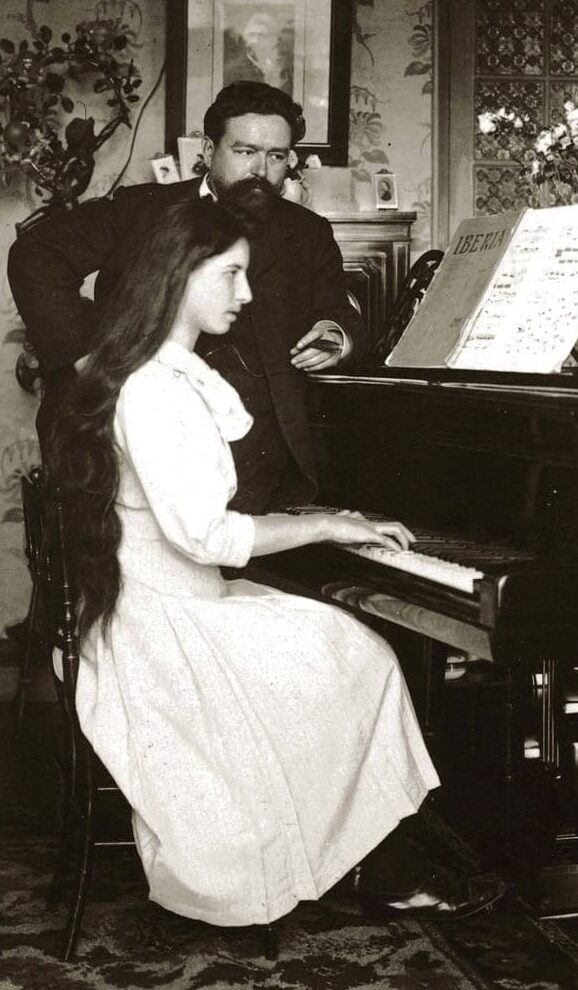
In the case of Italian pianist Clara Sansoni, the reasoning is not clear. The artist was trained and admired by many legendary musicians in her early years, among them Isaac Albéniz, Francis Planté, and Gabriel Fauré. While she is documented as having performed publicly between 1901 and 1955 and appears to have been favourably perceived by critics and public alike, she made no commercial recordings. She was 83 when she died in 1977, having not been before the public for at least two decades.
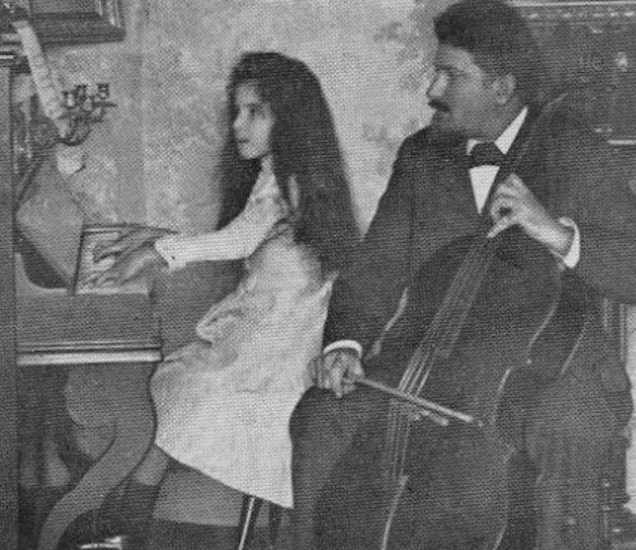
Clara Sansoni was born in Pistoia (Italy) on June 29 1893, the daughter of Carlo Sansoni, principal cello of Montecarlo Orchestra, and Anna Wilmes, a Luxumbourg-born musician who introduced Clara to the piano when she was four. Clara’s first appearance in public was when she was 8 (not 7 as was advertised at the time), during which she accompanied her father. At age 10 she debuted with orchestra at the Casinò in Montecarlo, performing the Haydn Concerto in D major, with Léon Jehin conducting. At 13, she debuted at the Salle Erard in Paris performing the Bach-Liszt Fantasie and Fugue, Beethoven’s Concerto No 3 in C Minor, and Grieg’s Concerto in A Minor.
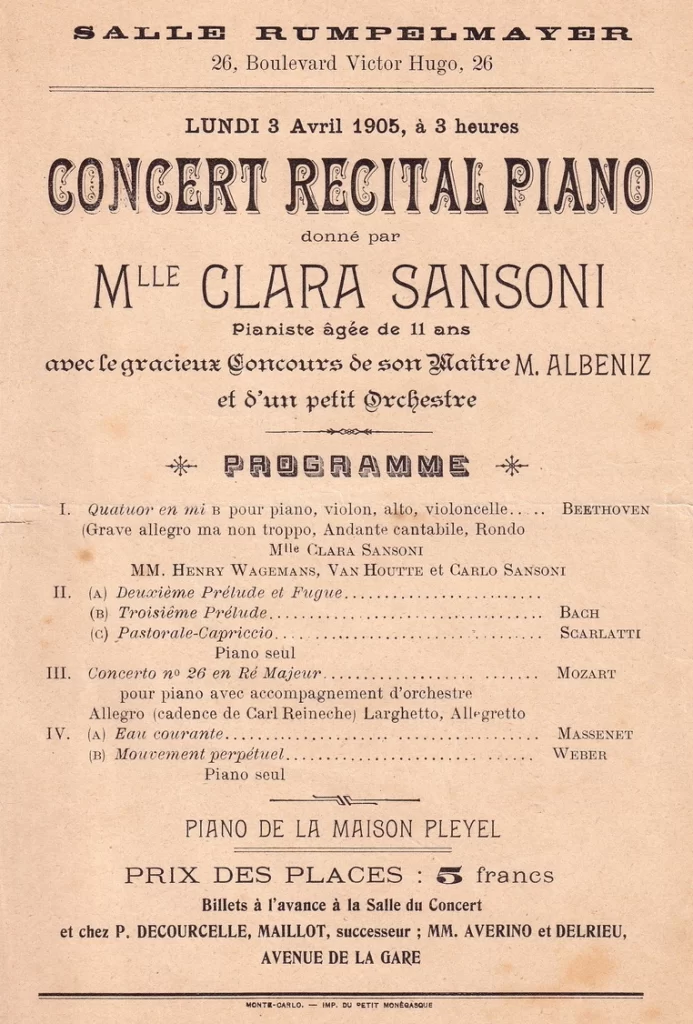
At the age of 12 in 1905, Clara started studying under Isaac Albéniz – they performed a concert together that year (on the left) – and she was under his guidance until the composer’s death in 1909. When the composer was asked to play his own composition “Iberia”, he answered that he couldn’t and suggested that they ask Sansoni to play it instead. In 1913 Clara spent her summer in Mont-the-Marsan, France at the house of Francis Planté, a pupil of Antoine Marmontel who was born during Chopin’s lifetime (he never heard Chopin play but knew musicians who had) and also met Mendelssohn and Liszt. She perfected her technique and musicianship with the venerable French pedagogue as she continued to give highly-acclaimed public performances.
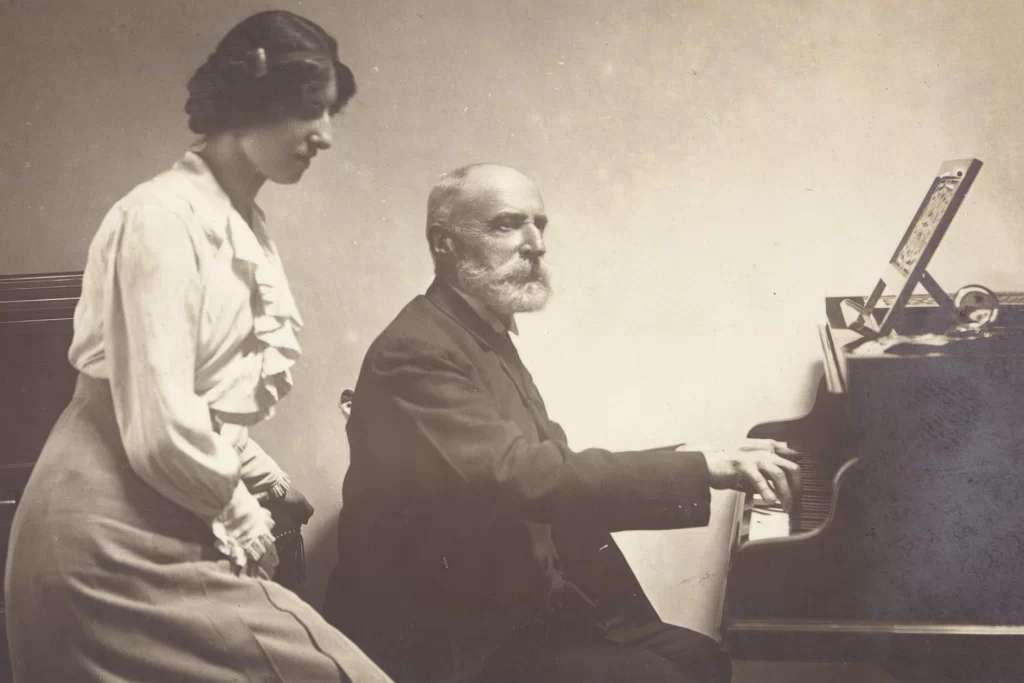
Clara performed in Paris, Nice, Monte Carlo, London, Barcelona, Ostend and throughout Italy, and everywhere she had great success and rave reviews. After 1927, her activity slowed down, and she resumed briefly after the Second World War and during the 1950s. Clara died in Florence on the 23rd of April 1977.
While Sansoni did not make commercial recordings, there is one that is known to exist: a recording that she made late in life in 1971, when she was 78 years old and had not been performing for many years. The piano is very regrettably quite out of tune, yet within the first few moments of listening it is clear that it is an artist of refined sensibility and tremendous authority who is performing.
The two works from Iberia are particularly fascinating, as she had learned from the composer how to play it. Particularly in the opening Evocación, the clarity of the sustained singing line is extraordinary, as is the suppleness of the nuancing in timing, dynamic adjustments, and pedal effects. In the Chopin Nocturne she demonstrates marvellous lyrical phrasing and timing, while the Revolutionary Etude is remarkably heroic while maintaining clarity of tone and phrasing – obviously not a blazing reading of a firebrand youth but still a fiery reading for a pianist of any age. In the Beethoven, she plays not only with great passion but with impeccably clear melodic lines – as evenly and consistently voiced in the left hand as in the right.
It is to be hoped that more recordings of this great pianist – perhaps some radio broadcasts – will be located. In the meantime, we can be grateful that we have this amazing recording. Many thanks to Clara’s grandchildren, to Fabrizio Corona for coordinating access to the recording and documents from the family archive, and to Federico Rossi for having translated some Italian documents.
0:00 Albéniz – Evocación
5:18 Albéniz – El Puerto
9:16 Chopin – Nocturne in C Minor Op.48 No.1
15:40 Chopin – Etude in C Minor Op.10 No.12, “Revolutionary”
18:31 Beethoven – Sonata No.23 in F Minor Op.57, “Appassionata”
– 2nd mvt – 28:24
– 3rd mvt – 34:33
Many thanks to Clara’s grandchildren, to Fabrizio Corona for coordinating access to the recording and documents from the family archive, and to Federico Rossi for having translated some Italian documents.
Comments: 10
So very extraordinary! Clara Sansoni’s interpretations, particularly of Albeniz, are breathtaking in their lyricism and tonality. As a classical pianist (prodigy) and composer, I am spellbound.
Fantastic Albeniz, what a great reference for future generations. Thanks for bringing it to light
What is really regrettable is that she is nearly forgotten in Italy. And I must confesso that even myself, although being an absolute nerd about forgotten great pianists, hadn’t heard of this supreme artist.
Superb playing, both technically and musically. At 78, few could match her.
Beautiful, and another important document of a lost style of playing—the authentic performance style of this music.
Fantastic find, bravo. Just one small detail: Planté never heard Chopin play. He wrote this himself: ‘n’ayant jamais connu Chopin – ce qui fut je plus grand regret de sa vie…’. I don’t know who invented this but it is repeated over and over again.
Many thanks for this clarification – it is indeed far too-often repeated … I’ll edit the text accordingly!
I am so happy to share my sweet, loving, strong grandma with all of you! It is a deep emotion to hear her play again! Thanks to Fabrizio and my cousins for this wonderful treasure.
This is remarkable in her clear speaking Beethoven’s thoughts through music. Very evocative! Her Appasionata is amazing and despite the piano, my favorite version! So meaninful! Not just technical! Thank you for making it available!
Both illuminating and thoroughly musical. A distinct personality emerges, neither imitative nor derivative. She understands her instrument and the repertory she commands. More!